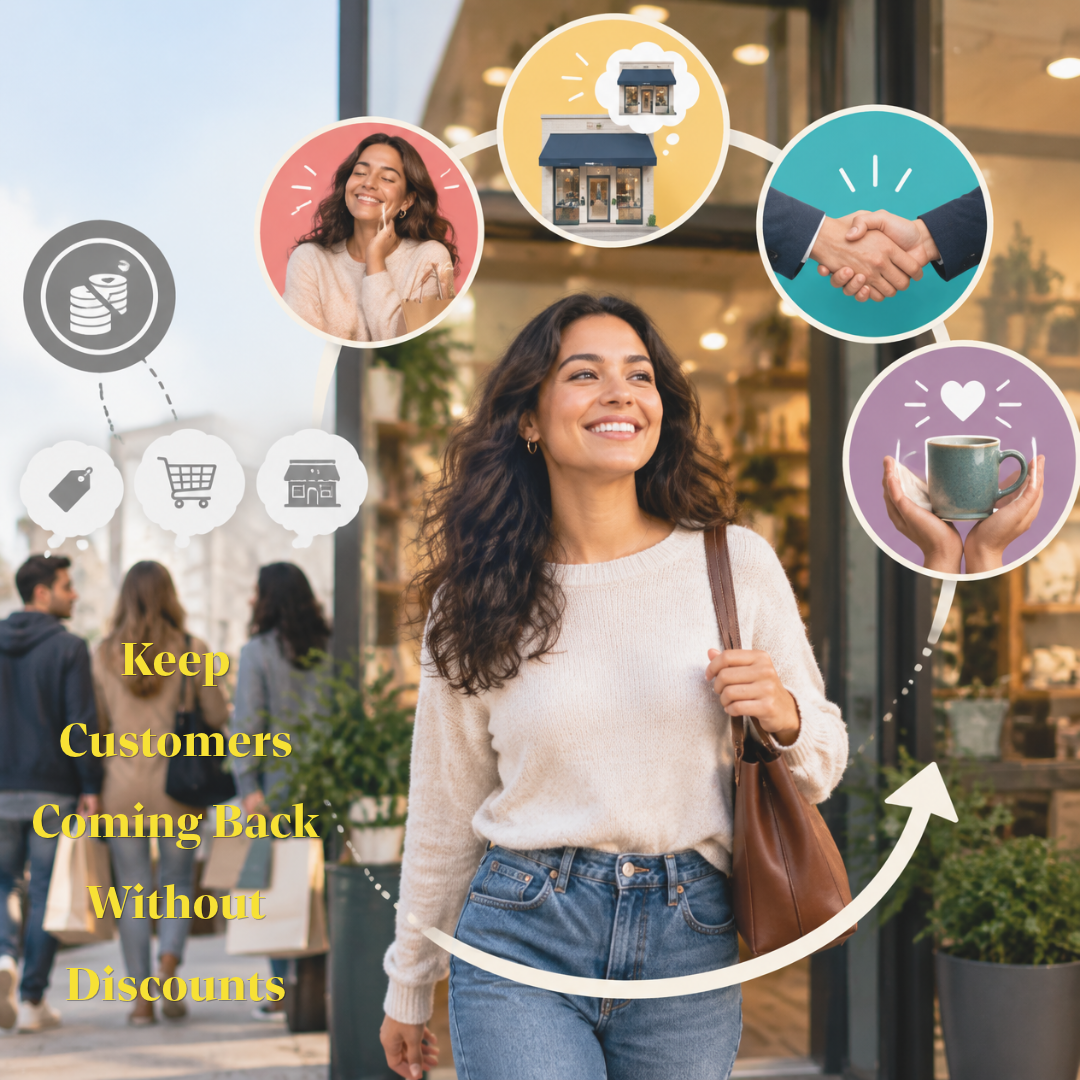
Keep Customers Coming Back Without Discounts
Your customers have choices. Are you giving them a reason to stay? Customers don't only go back to places they found the cheapest. They go back because they enjoyed the place they visited. Customers return to you because you gave them a reason to remember, trust, and value you and your products or services.
The Customer Who Never Came Back
A customer visits two businesses offering nearly identical services. One provides a discount. The other remembers their name, understands their needs, and follows up afterward.
Imagine a customer has visited two different pet stores. The first store has a great display, top notch toys and feed for all different animals, and loud advertising. The customer enjoys the modern look of the store, though it takes a while for someone to speak to them. When they do ask a question about products the employee says they have a discount going for 10% off certain toys only. That’s nice but the customer wants more options. They visit the second store, which is more of a mom-and-pop shop. Its display is great and has the same toys and feed as the last store. However, when the customer walks into the second pet store, they are immediately greeted with a warm “Hello, welcome in”. Someone meets them soon as they walk through the store and asks them what they are looking for. The employee helps the customer not only find what they are looking for but also talks them through the best practices for the product of choice. When the customer finally walks up to the register they are asked for their information to start a loyalty program that immediately discounts the customer's purchase.
Which business earns the next purchase?
Businesses spend a lot of time and resources attracting new customers through ads and marketing or large infrequent discounts. Though they often fall short in keeping those customers after the first purchase. Customer satisfaction is an important and frequently tracked metric by businesses of all sizes. The customer enjoying the intended outcome is how they keep coming back right? Not always. With an abundance of choices, customers could very well find themselves at your competitor's store because they invest in the continued customer experience well after they have made their first, fifth, or even tenth purchase. Building a relationship with your customers is a far better promise in the art of keeping them coming back, then a simple discount, or even worse nothing at all. What if the most valuable part of a sale happens after the customer pays?

Why Customers Leave Even When Nothing Goes Wrong
A customer doesn't have to dislike your business to forget about it. In marketing the main goal is simply to attract the attention of your ideal customer. However, once you finally have that attention and the purchase, you must keep their attention and satisfaction to make them want to return. Customers have limited attention and numerous alternatives when looking for their needs to be met. For them to choose your business, you have already achieved in getting their attention. What keeps them is knowing that they are valued. Feeling connected with you and your employees is beneficial the same as being satisfied with their purchases. People like to feel good. Even when they visit stores, they enjoy knowing that they will be remembered. Knowing customers by name, making sure that they are greeted warmly every time they walk in, and the convenience of being helped is how you leave no ambiguity. People want to feel connected to your business and that is up to you how you do it. Understand that businesses must give customers reasons to remember them between purchases. How will you accomplish that?
Five Ways to Make Customers Feel Valued Without Cutting Prices
Make it Personal: Remembering names, preferences or previous purchases creates a feeling of trust and paying attention to your customers. When people choose to frequent your business, it may be beneficial to incorporate ways that your employees can identify returning customers. Doing so will make those high value customers actually feel the value that you have provided them.
Follow up thoughtfully: Check whether the product or service met customer expectations. The follow up is just as important as getting the first purchase. Having a system for surveying your customers ensures that they continually get what they look for. The only thing better than completing a purchase is going beyond the purchase, making sure your customers get the same white glove service every time.
Give useful knowledge: Sharing knowledge about your business, products and services helps customers understand how you help them more and more. The better you are at spreading advice or giving helpful tips, the higher the chances of people buying from you again and again.
Offer early access: Increasing your service scope? Adding new products to your lineup? Allowing loyal customers early access to these new additions can increase that loyalty. Early access is equivalent to exclusivity and that is exactly what keeps loyal customers loyal. If new isn’t feasible, create a loyalty program with great incentives to keep customers engaged with your business and excited to keep buying from you.
Celebrate relationships: Anniversaries are a great form of recognition. When you highlight customer relationships whether for tenure or certain achievements - like with a reward system - this not only feels good for those achieving customers, but it also looks good for newer customers to strive for the same achievements.
These five ways show how a thoughtful $0 thank-you message sometimes creates more goodwill than a 10% discount.
Your Best Salespeople Might Already Be Your Customers
The long-standing adage goes that people buy from those they know, like, and trust. People are more likely to recommend a business when they trust it and feel confident putting their reputation behind it. People are always going to share experiences that they can never forget. When you create memorable moments for customers, they are bound to tell someone about it. Asking for referrals is always a great practice to keep. Though much easier to accomplish when you aim to earn recommendations from people. Having customer testimonials is also a great practice to have. Word of mouth still stands as one of the best methods of earning trust from others. When people hear how good you are from others, people will certainly see what all the hype is about. Are you giving customers an experience worth talking about?

Ask Better Questions, Build Better Experiences
Now after going through all of the effort of building a great environment, making customers feel valued, and creating experiences, you will want to know exactly how everyone feels about it all. Customer feedback is a great way to know just exactly what’s great and not so great about your business. People are going to talk about it; it’s best you know what they are saying and what actions you can take from having that information. Nowadays people can just leave you a review and tell you how good or bad you did. Though when you ask specific questions of your customers you can gather more accurate, and more effective data. When people tell you what they think and feel, you want to take action on those responses as soon as possible. Responding to customers' comments and concerns, letting them know you hear them is the first step. When you begin to take action, you can take small actions first. Little improvements have a compounding effect over time. When you listen to customers, they will tell you what they want. All you have to do is give it to them.
Three questions you can ask customers in feedback surveys:
What was the easiest part of working with us?
What could we have made easier?
What would make you choose us again?
The Customer Appreciation Strategy: A Simple 30-Day Experiment
A practical retention experiment that you can try with your customers.
Week 1: Identify 10 valuable or previously active customers.
Week 2: Reconnect with personalized messages that don't immediately ask for a sale.
Week 3: Add value by sharing a resource, useful recommendation, or relevant update.
Week 4: Evaluate responses, repeat purchases, referrals, and customer feedback.
Important distinction: Customer appreciation should feel like appreciation, not a disguised sales campaign.
Loyalty Is Built Between Purchases
As we’ve seen from the earlier example, low rates aren't the only way to garner loyalty from customers. As we just discussed, there are many ways for you to not only provide better service but also provide better experiences for customers. Low prices are enticing only from an initial glance. Being the cheapest isn’t always a great look, especially if the businesses have distinguishing factors like familiarity and following up with customers. Loyalty is built through consistent experiences, not just occasional promotions. If your competitors charged the same price tomorrow, what would make your customers choose you?
A discount gives customers a reason to buy today. A relationship gives them a reason to return tomorrow.